AI Mission Orchestration Platform
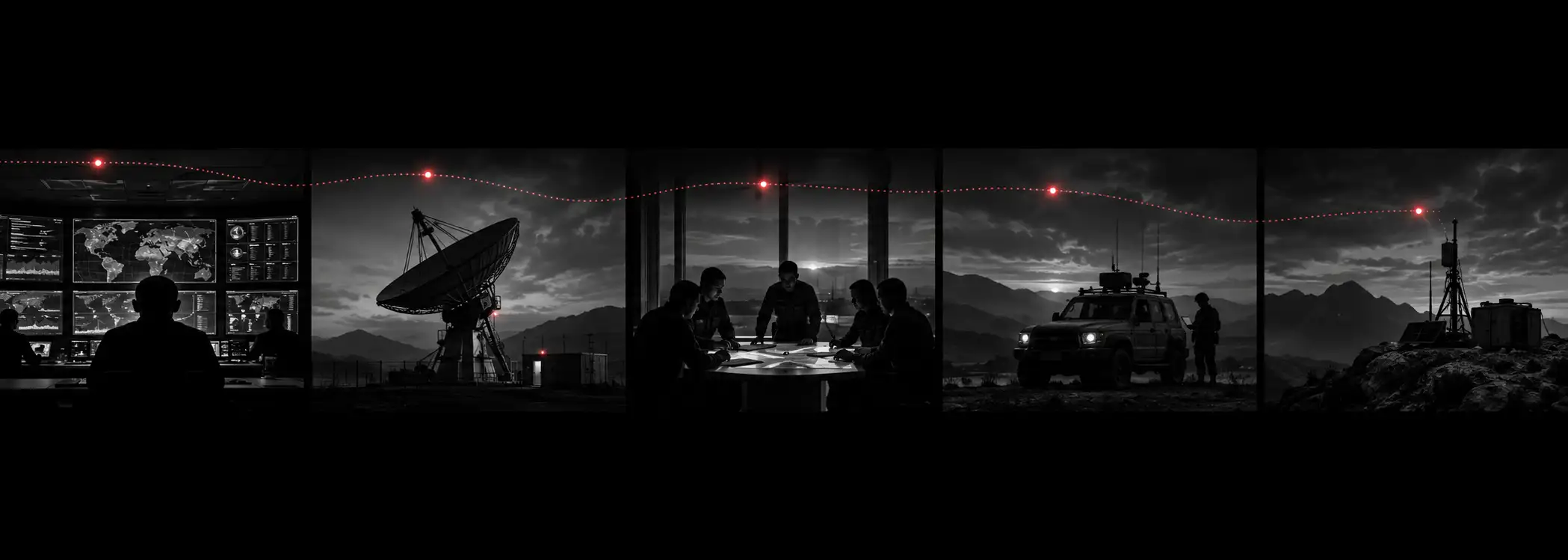
Mission Fabric™ is XRDNA's software-defined mission orchestration layer. It connects mission data, AI models, autonomous assets, and operational workflows into a unified architecture for faster planning, coordination, and execution in contested, distributed, and high-tempo environments.

Mission Fabric™ by XRDNA
Discover how Mission Fabric™ by XRDNA orchestrates mission operations across AI, architecture, defense, and autonomous systems
Overview
Mission Fabric™ helps teams unify mission planning, real-time data fusion, edge AI, predictive analytics, and autonomous-system coordination into a common operational layer. Built for defense, aerospace, and industrial environments, the platform supports decision advantage where speed, resilience, and interoperability matter most.
Mission Fabric™ is XRDNA's proprietary platform architecture for AI-enabled mission operations.
Plan, simulate, and adapt missions using intelligent workflows and operational context.
Integrate sensor, platform, environmental, and operational data into a unified mission picture.
Deploy decision-support capabilities across edge, cloud, and hybrid operational environments.
Support coordination across unmanned, autonomous, and human-operated systems.
Anticipate operational constraints, risks, opportunities, and mission outcomes.
Connect existing systems, data sources, and workflows through a flexible software-defined layer.
Architecture
Modern missions depend on fragmented data, distributed assets, human-machine teams, and rapidly changing conditions. Mission Fabric™ is designed to bring those elements together through a secure, modular, and extensible software architecture.
Siloed systems and incompatible formats across sensors, platforms, and command layers
Operators, AI agents, and autonomous systems working together in real-time
Dynamic operational environments requiring adaptive response and continuous replanning
Geographically dispersed platforms, sensors, and decision-makers
Mission Planning
AI-assisted workflow design and simulation
Situational Awareness
Unified operational picture from fused data
AI-Assisted Decisioning
Recommendations with explainable reasoning
Adaptive Execution
Dynamic response to changing conditions
Secure
Zero-trust architecture with SoI™-based access control
Modular
Composable services that adapt to mission requirements
Extensible
Standards-based integration with existing systems
Whether tracking a shipment across continents, orchestrating a satellite constellation, or coordinating field teams with autonomous systems—Manifests provide the fabric that keeps identity, location, and policy synchronized across every entity and every stop.
Manifests
Manifests create unified orchestration by bringing together multiple eVas and SoIs into a living, trackable mesh that moves with your mission.
Manifests bind People, Places, and Things into cohesive operational units with shared context.
Define complex journeys with origin, waypoints, destinations—even launch, orbit, and landing for space ops.
Every manifest inherits and enforces Sphere of Influence policies across all linked entities.
Field teams, operators, drivers, pilots—anyone involved in the mission gets tracked with identity and permissions.
Warehouses, depots, launch sites, landing zones—fixed locations that anchor your manifest's route.
Cargo, vehicles, drones, satellites, sensors—assets with real-time position tracking and telemetry.
The XRDNA dashboard provides a unified view of all manifests, with interactive maps, real-time tracking, and full control over routes and linked assets.
Visualize stops and live asset positions on a real-time map with status indicators
Filter by status (Pending, Active, Completed) and search across names, tags, and eVa addresses
Full route timeline, linked assets, reorder stops, and advance through the journey
Real-time tracking of "Thing" assets with 1-second updates and arrival notifications
What You See in the Dashboard
Stop 3 of 7 • 5 assets linked
eva://us.logistics/manifest/sc-alpha-2024
Capabilities
From ground logistics to space operations, Manifests adapt to your mission context.
origin - Starting point
waypoint - Intermediate stop
destination - Final delivery
launch - Space launch site
orbit - Orbital insertion
landing - Descent/recovery
{
"id": "manifest-uuid",
"name": "Satellite Deployment Alpha",
"status": "active",
"evaAddress": "eva://space.ops/manifest/sat-deploy-01",
"currentStopIndex": 2,
"stops": [
{ "type": "origin", "name": "Cape Canaveral" },
{ "type": "launch", "name": "Launch Window A" },
{ "type": "orbit", "name": "LEO Insertion" },
{ "type": "destination", "name": "Target Orbit" }
],
"assets": ["satellite-01", "ground-team", "mission-control"]
}1-second position polling
Automatic arrival detection
Battery & signal telemetry
Drag-and-drop reordering
Add/remove stops dynamically
Manual advance override
Bind manifests to SoIs
Layer visibility control
Policy inheritance
Whether you're handling mission-critical data, performing complex data analysis, or deploying LLMs across applications, Mission Fabric provides the infrastructure for scalable, secure, and intelligent data handling

Access data with high precision and speed

Uncover hidden patterns within interconnected data

Streamline LLM interactions with balanced load distribution and effective parsing

Leverage embedded models for in-context data processing tailored to unique user requirements
Architecture
A unified platform connecting assets, manifests, and AI orchestration across Earth, space, and beyond.
Assets Mode: Browse Earth, Satellite, Lunar, and Mars inventories
Logistics Mode: Track manifests, stops, and live asset positions
CCMD Mode: Military operations with threat assessment and component forces
MoE Layout: Immersive 3D globe with AI assistant integration
3D Globe (Earth/Moon/Mars)
Inventory Browser
Satellite Tracker
AI Assistant Panel
Field operators & personnel
Identity & permission tracking
Assignment relationships
Facilities & ground stations
Data centers & launch sites
Geofenced boundaries
Satellites & sensors
Vehicles & cargo tags
Real-time position telemetry
{
"id": "asset-uuid",
"name": "Ground Station Alpha",
"type": "place",
"kind": "ground-station",
"status": "online",
"evaAddress": "eva://us.ca.mojave/facility/gs-alpha",
"coordinates": { "lat": 35.0527, "lon": -117.6673 },
"relationships": [
{ "type": "monitors", "targetId": "sat-001" },
{ "type": "connected_to", "targetId": "dc-west" }
]
}assigned_to
located_at
mounted_on
connected_to
depends_on
monitors
routes_through
parent_of
Context-Driven Intelligence
Visualize relationships, dependencies, and communication patterns between bounded contexts, teams, and systems with unprecedented clarity.
Traditional mapping tools show where things are. Mission Fabric shows how they relate. By combining eVa™'s universal addressing with SoI™'s zero-trust access control, we create living maps that understand context, respect boundaries, and reveal hidden dependencies across your entire organization.
Every context, team, and asset receives a unique eVa™ address, enabling precise navigation and relationship mapping across realms (CORE, ORIGINS, SOCIAL, EXPANSE).
Sphere of Influence™ ensures that context maps respect organizational boundaries. Teams see only what they're authorized to see, with granular layer-based permissions.
Instantly visualize upstream and downstream dependencies between bounded contexts, revealing critical paths and potential bottlenecks in your system architecture.
Map and analyze how teams and systems communicate, identifying integration points, data flows, and opportunities to optimize cross-context collaboration.
eVa™ (Elastic Vector Addressing) provides the universal coordinate system that makes context-driven maps possible:
Sphere of Influence™ (SoI™) ensures context maps maintain security and appropriate visibility:
Core Capabilities
XRDNA's Mission Fabric™ architecture delivers six core capabilities designed for contested, distributed, and high-tempo operational environments.
Plan, simulate, and adapt missions using intelligent workflows and operational context.
Integrate sensor, platform, environmental, and operational data into a unified mission picture.
Deploy decision-support capabilities across edge, cloud, and hybrid operational environments.
Support coordination across unmanned, autonomous, and human-operated systems.
Anticipate operational constraints, risks, opportunities, and mission outcomes.
Connect existing systems, data sources, and workflows through a flexible software-defined layer.
Contested environments — designed for degraded, denied, and intermittent connectivity
Human-machine teaming — seamless coordination between operators and autonomous systems
Decision advantage — faster OODA loops through AI-assisted analysis and recommendations
Complex operations — orchestrate workflows across distributed facilities and teams
Asset optimization — predictive maintenance, route planning, and resource allocation
System integration — connect legacy systems through standards-based interfaces
Mission Fabric leverages advanced graph-based algorithms to retrieve relevant nodes swiftly, allowing users to access precise information from complex, interconnected datasets
Maps and visualizes relationships between nodes to reveal the connections and patterns within datasets. This feature is particularly valuable for understanding data context, uncovering trends, and enhancing decision-making processes
By connecting relevant data points, Mission Fabric highlights correlations and dependencies that would otherwise remain hidden, providing a comprehensive view of the data landscape
Protocols
Universal addressing for assets, manifests, and operations with MCP tool orchestration.
// Universal addressing scheme
eva://domain/type/identifier
// Examples
eva://us.logistics/manifest/sc-alpha-2024
eva://space.ops/satellite/sat-001
eva://us.ca.mojave/facility/gs-alpha
eva://mil.ccmd/operation/op-thunderstriketype Manifest = {
id: string;
evaAddress: string;
status: 'pending' | 'active' | 'completed';
currentStopIndex: number;
stops: Stop[];
assets: AssetRef[]; // People, Places, Things
soi: SphereOfInfluence;
}{
"name": "mission.fabric",
"tools": [
{ "name": "manifest.create" },
{ "name": "manifest.addStop" },
{ "name": "manifest.advance" },
{ "name": "asset.track", "realtime": true },
{ "name": "asset.link" },
{ "name": "soi.apply" }
]
}type Stop = {
type: 'origin' | 'waypoint' | 'destination'
| 'launch' | 'orbit' | 'landing';
name: string;
coordinates?: { lat: number; lon: number };
eta?: Date;
arrivedAt?: Date;
status: 'pending' | 'current' | 'completed';
}Mission Fabric’s vector database indexes data based on contextual similarity, enabling rapid retrieval of relevant information. This indexing method ensures that related data is grouped and accessible, improving search efficiency and data relevance
The vector database allows for a high level of accuracy in data retrieval, ensuring that similar data points are indexed together and surfaced based on user queries
Optimized for high-speed, real-time access, the vector database supports both small-scale operations and extensive enterprise-level datasets
Security
Location-secured and timeline-enforced policies across all assets and manifests.
Private — Owner-only access
Social — Team/org sharing
Public — Open discovery
Policy inheritance for linked assets
Geofenced operational boundaries
Route deviation alerts
Coordinate-based access control
Zone entry/exit notifications
Stop-based permissions
Time-windowed access grants
Automatic policy transitions
Journey completion verification
Risk-tiered human-in-the-loop for sensitive operations
Multi-party approval for cross-SoI manifests
Automatic escalation for route changes
Asset linking requires owner consent
Complete journey history with timestamps
Asset interaction logging
Policy enforcement audit trail
SIEM export for compliance reporting

Mission Fabric powers real-time intelligence and optimized performance for organizations requiring reliable, contextual data solutions, enabling impactful insights across industries.
Explore NV works with eVa to codify and secure data provenance
Examples
Real-world manifest orchestration scenarios across logistics, space, and defense domains.
manifest: "Supply Chain Alpha"
evaAddress: eva://us.logistics/manifest/sc-alpha
status: active
currentStop: 3 of 7
stops:
- origin: "LA Warehouse" ✓
- waypoint: "Phoenix Hub" ✓
- waypoint: "Denver Distribution" ← CURRENT
- waypoint: "Chicago Terminal"
- destination: "NYC Fulfillment"
assets:
- person: "Driver-142" (tracking)
- thing: "Truck-FL-8823" (1s polling)
- thing: "Cargo-RFID-9921"
soi: Social | approvals: route-changemanifest: "LEO Constellation Deploy"
evaAddress: eva://space.ops/manifest/leo-deploy-24
status: active
currentStop: 2 of 4
stops:
- origin: "Cape Canaveral" ✓
- launch: "T+00:45:00" ← CURRENT
- orbit: "LEO Insertion 400km"
- destination: "Target Constellation Slot"
assets:
- thing: "Sat-Comm-07" (telemetry)
- place: "Mission Control Houston"
- person: "Flight Director Chen"
soi: Private | approvals: all-stopsmanifest: "Cross-Domain Transfer"
evaAddress: eva://mil.ccmd/manifest/xfer-alpha
status: pending
currentStop: 0 of 5
stops:
- origin: "Base Alpha" (geofenced)
- waypoint: "Airspace Corridor 7"
- waypoint: "Maritime Rendezvous"
- waypoint: "Foreign Port Entry"
- destination: "Embassy Compound"
policies:
- soi transitions at each stop
- multi-party approval required
- real-time position encryptionagent: "Logistics Optimizer"
goal: "Reduce delivery time by 15%"
workflow:
- discover: all active manifests
- analyze: route efficiency scores
- simulate: alternative stop ordering
- propose: optimized routes
- await: human approval
- execute: route updates
context:
- access: Social SoI manifests
- permissions: read + propose
- constraints: no cost increaseEmbedded models within Mission Fabric enable the platform to perform in-context data processing, extracting meaningful insights and adapting to real-time user inputs
The embedded models can be tailored to various data types and user needs, enhancing the platform’s adaptability across different applications
These models process data within its unique context, ensuring that the information delivered is relevant, actionable, and reliable for users in both high-stakes and day-to-day scenarios
API
RESTful endpoints for manifests, assets, and real-time tracking with MCP tool integration.
// Create manifest with stops
POST /v1/manifests
{
"name": "Supply Chain Alpha",
"soi": "Social",
"stops": [
{ "type": "origin", "name": "LA Warehouse" },
{ "type": "waypoint", "name": "Phoenix Hub" },
{ "type": "destination", "name": "NYC Center" }
]
}
// Advance to next stop
POST /v1/manifests/{id}/advance
// Get manifest status
GET /v1/manifests/{id}/status// Link asset to manifest
POST /v1/manifests/{id}/assets
{
"assetId": "truck-fl-8823",
"type": "thing",
"tracking": true
}
// Get asset position (real-time)
GET /v1/assets/{id}/position
// List assets by type
GET /v1/assets?type=thing&status=active// Subscribe to position updates (WebSocket)
WS /v1/tracking/subscribe
{ "assetIds": ["truck-001", "driver-142"] }
// Get journey history
GET /v1/manifests/{id}/history
// Check geofence status
GET /v1/assets/{id}/geofence// Add stop to manifest
POST /v1/manifests/{id}/stops
{ "type": "waypoint", "name": "New Hub" }
// Reorder stops
PUT /v1/manifests/{id}/stops/reorder
{ "order": [0, 2, 1, 3] }
// Remove stop
DELETE /v1/manifests/{id}/stops/{stopIndex}Mission Fabric functions as a load balancer between large language models (LLMs), managing requests and distributing tasks to optimize performance and resource usage
Acts as a parser, breaking down complex queries and routing them to the appropriate LLM or model, ensuring accuracy and reducing processing time
By balancing and parsing requests between LLMs, Mission Fabric prevents overload, reduces latency, and ensures that each request is handled by the best-suited model for the task
Get started
XRDNA's Mission Fabric™ platform is ready for deployment in defense, aerospace, and industrial environments. Our team will help you integrate with existing systems and configure the platform for your operational requirements.
AI Mission Planning
Intelligent workflows and operational context
Data Fusion
Unified mission picture from all sources
Edge-to-Cloud
Deploy anywhere operations demand
Mission Fabric™ and XRDNA Mission Fabric™ are trademarks of XRDNA, Inc. All rights reserved.